
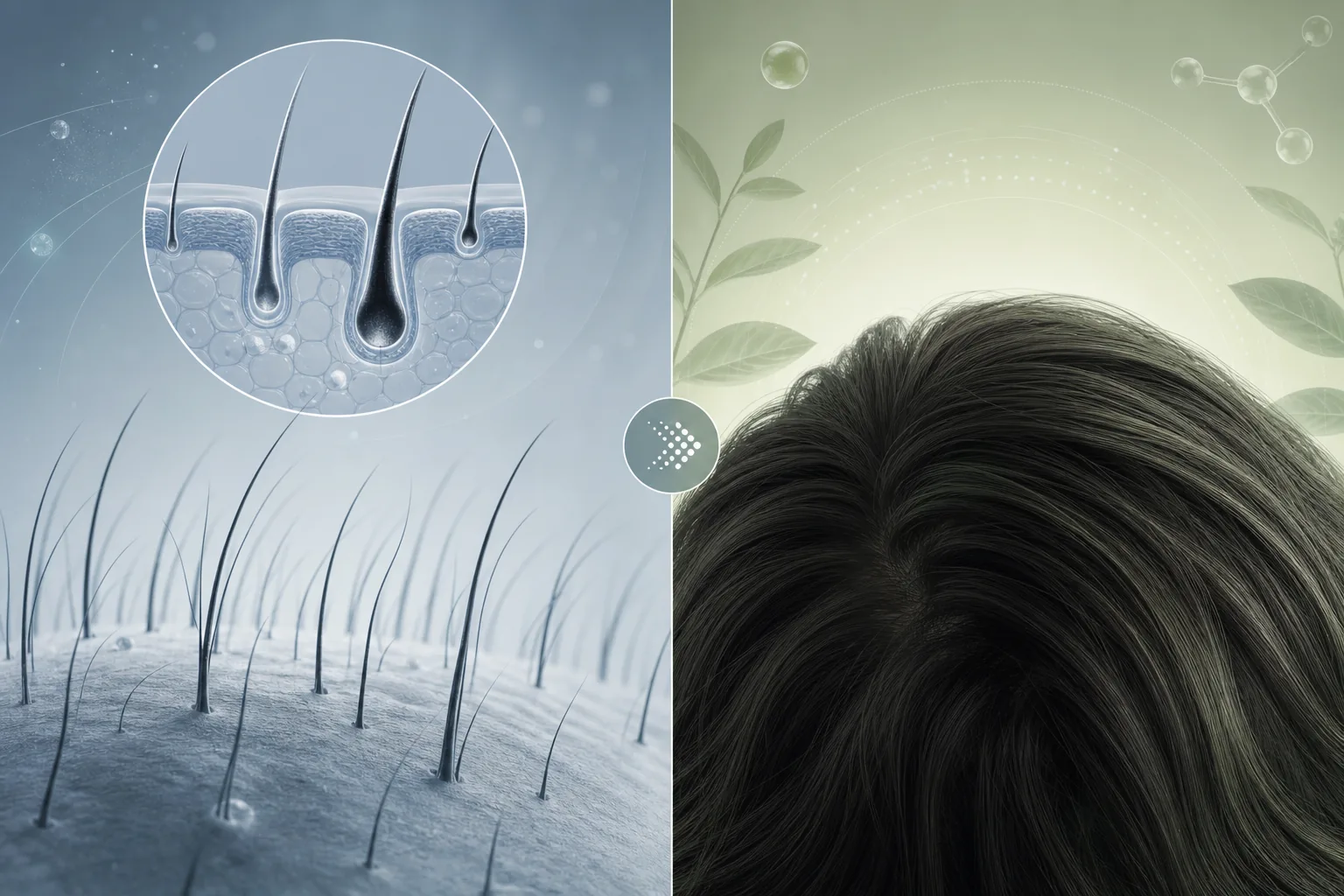
Social feeds love a hair transformation tile. Without controls, those tiles can mislead kindly people who already feel vulnerable about thinning.
Why angles lie kindly
Part depth shifts apparent density. Tilting the crown toward the lens exaggerates scalp show-through; tilting away flatters. Always demand consistent distance and focal length when comparing month six to month zero.
Wet hair looks thinner than dry hair; harsh bathroom down-light rivals stage lighting for cruelty.
Length and colour tricks
Growing hair longer can mask miniaturised zones by weighing down nearby fibres. Fresh dye reduces contrast between hair and scalp. Neither proves a molecule worked — they prove styling changed.
Concurrent treatments
Many users stack minoxidil, microneedling, ketoconazole shampoo, oral anti-androgens, or low-level light devices. Attribution becomes a soup. Honest posts list every variable; suspicious ones spotlight a single ingredient.
Our finasteride comparison explains why systemic DHT modulation and topical receptor blockade are not interchangeable wins.
Reasonable timelines
Hair cycles span months. Visible cosmetic shifts often require two photography seasons minimum, sometimes longer at the vertex. Stories that explode in “three weeks” deserve extra scrutiny.
Selection bias online
People who fail quietly rarely post updates. Survivorship bias inflates apparent success rates. Anchor expectations using NHS dermatology discussions about first-line agents before chasing grey-market anecdotes.
DIY documentation tips
If a specialist supervises any plan, ask whether you may photograph at visits with standardised positions. At home, use the same wall, daylight or ring-light setting, and phone tripod height.
Record concurrent stressors: illness, crash dieting, postpartum windows — all move hair independent of topicals.
Emotional safety
Comparison loops can harm mood. Limit scrolling, bookmark rational guides like our safety overview, and remember that your scalp is not their scalp.
Pulling it together
Before-and-after imagery is a diary hint, not a clinical trial. Pair visuals with practitioner follow-up, not with checkout carts.
Camera settings matter
Automatic phone HDR lifts shadows and tames highlights inconsistently between sessions. Manual exposure lock on a mid-grey reference (a blank wall) reduces this bias when you photograph monthly.
Vertex versus hairline
The vertex is harder to self-photograph; people lean mirrors awkwardly and change tilt without noticing. Use a second person occasionally to standardise the view — that is how trials often operate.
Miniaturisation counts
Trichoscopy in clinics counts miniaturised hairs versus thick terminal fibres. Smartphone pixels cannot substitute, yet patients educated about the concept grow less mesmerised by flashy macros.
Seasonal shedding
Many people notice a telogen effluvium bump after illness, surgery, or iron deficiency correction. A seasonal shed can mimic treatment failure. Clinicians may pull a hair pull test or arrange ferritin review.
Ethics of posting minors
Teenagers with early androgenetic patterns sometimes appear in forums. Guardians should think twice before publishing identifying scalp shots; digital permanence outlives embarrassment.
Commercial photography standards
Legitimate brands submitting to regulators maintain lighting diagrams and raw files. Consumer posts owe nobody that rigour — adjust scepticism accordingly.
Trans hair journeys
Gender-affirming hormone therapy rearranges hair expectations on its own timeline. Layering speculative topicals without endocrine context risks narrative confusion in before-and-after arcs.
When improvement stalls
Plateaus can mean you reached the genetically predictable ceiling, not that “the molecule stopped working.” Reassessment with a dermatologist clarifies whether camouflage fibres, toppers, or surgery enter the chat.
Healthy scepticism checklist
Ask for dates on photos, list concurrent drugs, query filter use, and prefer writers who document failure months too. Humility is a credibility marker.
Crown swirl photography
The whirl at the vertex moves hair angles in a spiral; minor head rotation changes shadow deposition dramatically. Photographers sometimes bracket three shots per session and still disagree which is “truest.”
Software sharpening
Phone default sharpening increases edge contrast around hairs, creating an illusion of density. Turning off beauty filters matters for personal documentation.
Wigs and toppers
Some timelines leap in fullness because the person added a topper without stating it. Ethical disclosure should normalise cosmetic aids rather than treat them as secrets that invalidate a journey.
Religious head covering
Friction from fabrics and intermittent washing rhythms affect sebum distribution. Community-specific routines deserve respectful discussion without flattening identity into a before snapshot.
Greying overlap
New grey hairs alter reflectance and perceived thickness even if fibre count is flat. Colourimetry nerds joke about “optical thickening via pigment loss” — less funny if you misunderstand it as regrowth.
Professional photography consent
Clinic galleries should use consent forms specifying reuse. If you suspect theft of clinic images for commerce, report through the original practice.
Pandemic hair sheds
Post-viral telogen effluvium surged in telemedicine queues. Timelines crossing 2020–2022 deserve explicit mention when evaluating any topical claim from that window.
Smartphone lens upgrades
Changing iPhone generations alters computational sharpening defaults. Note hardware jumps in diaries or risk phantom density.
Scalp micropigmentation
SMP creates optical density without fibre growth. Before-and-after boards mixing SMP and pharmaceuticals without labels confuse viewers.
Religious pilgrimage stress
Long fasting or extreme heat exposure during travel can transiently alter shedding. Context cards belong in honest timelines.
Digital literacy trainings
Public health teams sometimes teach teenagers to read influencer healthcare posts sceptically; those skills apply directly to hair threads.
Barbers as documentarians
Trusted barbers photograph crowns routinely; asking politely for consistent shots can supplement home efforts if you already visit monthly.
Finally, remember regression to the mean: a scary shed after starting any intervention sometimes settles without heroics. Document the trough, not only the peak, when you share publicly.